

Beyond the Single Speaker: Finding Your Perfect Multi-Room Bluetooth Set
Discover your ideal multi room bluetooth speaker set. Compare Wi-Fi vs. Bluetooth, key features, and setup for whole-home audio bliss.
Why a Multi-Room Bluetooth Speaker Set Transforms Your Home Audio Experience
A multi room bluetooth speaker set lets you fill your entire home with music, creating the same listening experience everywhere or different soundscapes in each room. Unlike carrying a single speaker from room to room, a proper multi-room system keeps your audio synchronized and easily controlled from your smartphone.
Quick Answer: Best Multi-Room Bluetooth Speaker Sets
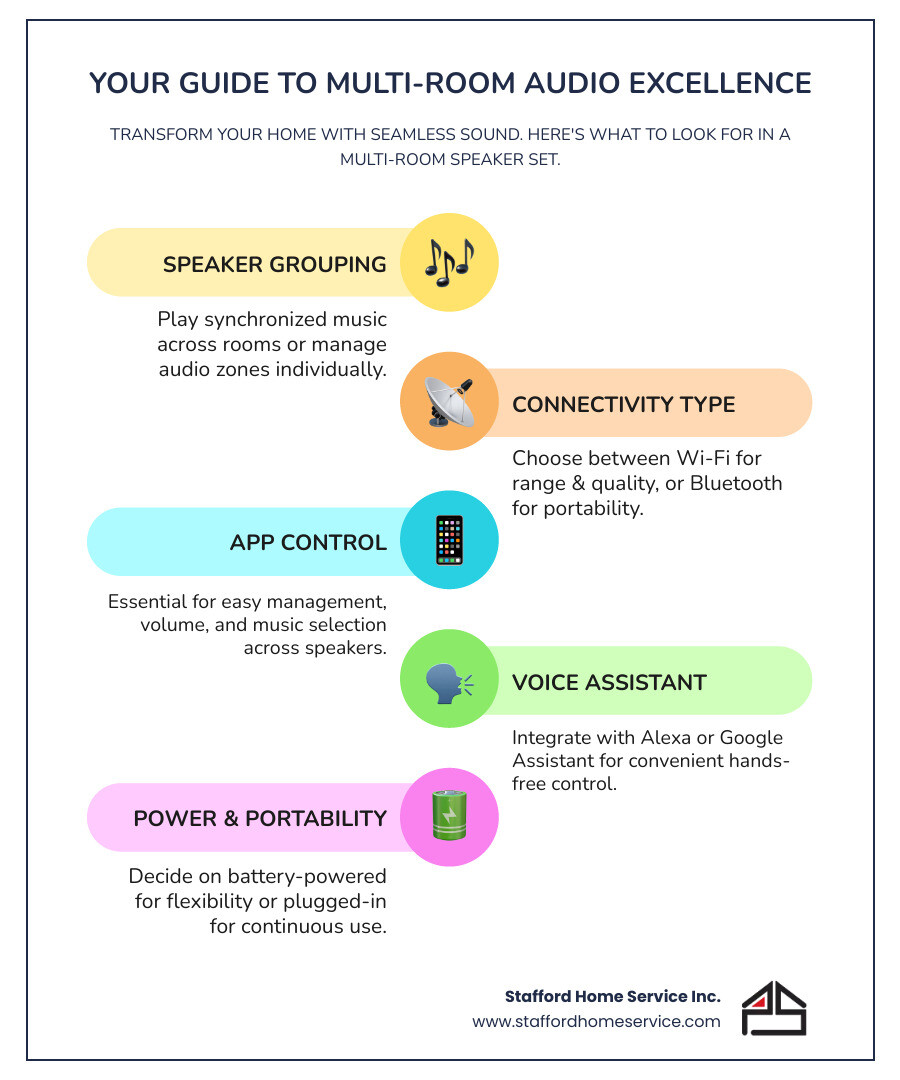
- Look for systems that support speaker grouping - This lets you play the same music everywhere or control rooms individually
- Check if speakers use Bluetooth, Wi-Fi, or both - Wi-Fi offers better range and quality; Bluetooth provides portability
- Verify app control capabilities - A good app makes managing multiple speakers simple
- Consider voice assistant integration - Works with Alexa or Google Assistant adds hands-free convenience
- Decide between portable battery-powered or plugged-in speakers - Based on where you'll use them most
The global multi-room audio market is growing fast, projected to reach $27.8 billion by 2030, as more homeowners find the convenience of whole-home audio. What used to require expensive built-in systems now works through affordable wireless speakers that you can set up yourself in minutes.
If you're planning a complete smart home setup with integrated entertainment systems, Stafford Heating, Cooling, Plumbing & Electrical can help design the perfect solution. For immediate assistance with your home's audio or other smart home needs, reach out to our team today.
The beauty of modern multi-room audio is its flexibility. You can start with just two speakers and expand over time. Whether you're hosting a party, working from home, or simply moving through your daily routine, your music follows you seamlessly from the kitchen to the bedroom to the patio.
Bluetooth vs. Wi-Fi: Understanding Your Wireless Options
When you're shopping for a multi room bluetooth speaker set, you'll quickly find that "wireless" actually means two very different things. The technology powering your speakers—Bluetooth or Wi-Fi—makes a huge difference in how they sound, how far they reach, and how well they work together throughout your home.
Both technologies have freed us from the days of running speaker wire through walls (though professionally wired systems still offer advantages we'll discuss later). But choosing between Bluetooth and Wi-Fi isn't about picking a winner—it's about matching the technology to how you actually live and listen.
Bluetooth creates a direct connection between your phone and a speaker. It's simple, fast, and doesn't need your home network. You can pair a speaker in seconds and take it anywhere.
Wi-Fi connects your speakers through your home network instead. This opens up longer range, better sound quality, and smarter features like streaming different songs to different rooms or synchronizing music throughout your entire house.
The key differences break down like this: Range matters if you have a larger home—Bluetooth typically reaches 30 to 50 feet, while Wi-Fi covers your entire network, often 100 feet or more. Audio quality is where Wi-Fi really shines, supporting high-resolution formats that Bluetooth's compression can't match. Portability favors Bluetooth since you're not tied to a network. Setup simplicity is excellent with both, though Bluetooth edges ahead for pure speed. Inter-brand compatibility gets tricky—Bluetooth usually requires matching brands, while Wi-Fi platforms like AirPlay 2 and Chromecast built-in let different brands work together.
A newer technology called Bluetooth Auracast is starting to change the landscape. Part of Bluetooth LE Audio, Auracast lets one audio source broadcast to multiple receivers simultaneously—not just speakers, but earbuds and even hearing aids. This could make Bluetooth multi-room setups more practical, especially for shared listening experiences.
So which technology should you choose? Think about your main use. If you're hosting backyard barbecues or want a speaker you can grab and go, Bluetooth's your friend. If you want consistent, high-quality audio throughout your home with smart features and rock-solid reliability, Wi-Fi is the better foundation.
The Simplicity of Bluetooth
There's something beautifully straightforward about Bluetooth. You turn on a speaker, tap it on your phone's Bluetooth menu, and you're playing music within seconds. No apps to download, no network passwords to enter, no complicated setup process.
This direct device-to-speaker connection makes Bluetooth incredibly portable. Take a speaker to the beach, your friend's house, or out on the patio without worrying about Wi-Fi coverage. It's ideal for outdoor use and temporary setups—anywhere you want music right now without fussing over infrastructure.
Modern Bluetooth speakers have gotten impressively capable. Many now feature Bluetooth 5.3 or 5.4, offering better stability and efficiency than older versions. True Wireless Stereo (TWS) pairing lets you connect two identical speakers for a proper left-right stereo experience.
Some manufacturers have even developed proprietary systems to link multiple Bluetooth speakers together, creating a multi room bluetooth speaker set without Wi-Fi. While these systems don't typically match the sophistication of Wi-Fi-based solutions, they work well for simpler setups where ease of use is the top priority.
The Power of Wi-Fi
For whole-home audio that truly feels seamless, Wi-Fi is where the magic happens. When your speakers connect through your home network instead of directly to your phone, they gain access to much more than just your music library.
The greater range means your music follows you from the basement to the second floor without dropouts or dead zones. The stable connection doesn't compete with phone calls or other Bluetooth devices. And perhaps most importantly, Wi-Fi's bandwidth supports higher fidelity and Hi-Res audio streaming—we're talking 24-bit/192kHz quality that preserves every detail the artist recorded.
Wi-Fi systems open up smart features that Bluetooth simply can't match. You can play jazz in the living room while the kids listen to something entirely different upstairs. Or synchronize the same playlist throughout your entire home for parties, creating that magical feeling where the music just exists everywhere without any noticeable delay between rooms.
Integration with streaming services happens seamlessly—no need to keep your phone connected and draining its battery. Many Wi-Fi speaker systems work directly with Spotify, Apple Music, and other services, letting you control everything through their apps or voice assistants.
The home network connection does mean you need decent Wi-Fi coverage throughout your home. If you have dead spots, your audio system will too. But for most modern homes with good routers, Wi-Fi provides the foundation for a truly impressive multi-room audio experience that grows more capable over time.
Key Features for Your Ideal Multi-Room Bluetooth Speaker Set
Once you've considered the fundamental differences between Bluetooth and Wi-Fi, it's time to think about the specific features that will make your multi room bluetooth speaker set truly work for your lifestyle. The goal isn't just filling every room with sound—it's about creating a listening experience that feels effortless, sounds beautiful, and fits seamlessly into how you actually live.
Sound Quality: From Ambiance to Audiophile
Let's be honest—what good is music everywhere if it doesn't sound good? Sound quality should be at the top of your priority list when choosing a multi-room system. We're talking about more than just volume here. True quality comes from clarity, depth, and that rich, full-bodied sound that makes you stop and really listen.
The magic happens inside the speaker. Quality drivers and amplifiers work together to reproduce your music accurately. You'll often see wattage mentioned in speaker specs, which tells you about power output, but don't get too hung up on numbers alone. The overall acoustic design matters just as much.
If you're serious about your music, High-Resolution Audio support becomes essential. Wi-Fi-based systems like Bluesound can stream tracks up to 24-bit/192kHz, preserving every nuance the artist recorded. Traditional Bluetooth has its limits because it compresses audio, but newer Bluetooth codecs like AAC and aptX have dramatically narrowed that gap, delivering surprisingly impressive wireless sound.
The world of immersive audio is getting exciting too. Spatial Audio and Dolby Atmos create a three-dimensional soundstage that wraps around you rather than just hitting you from the front. Speakers like the Sonos Era 300 bring this cinema-style experience to your living room. Pantheone Audio focuses on stereo listening for spatial effects and true-to-life sound reproduction that makes you feel like you're sitting in the recording studio with the musicians.
Connectivity and Control
Here's where a multi-room system either becomes a joy to use or a daily frustration. The best systems feel intuitive, almost invisible in their operation.
The Bluetooth version matters more than you might think. Look for Bluetooth 5.0 or newer for better range, rock-solid stability, and improved battery efficiency if you're using portable speakers. But for true multi-room functionality, Wi-Fi capability becomes your best friend. It provides the stable backbone needed for synchronized playback across multiple rooms and handles high-quality streaming without breaking a sweat.
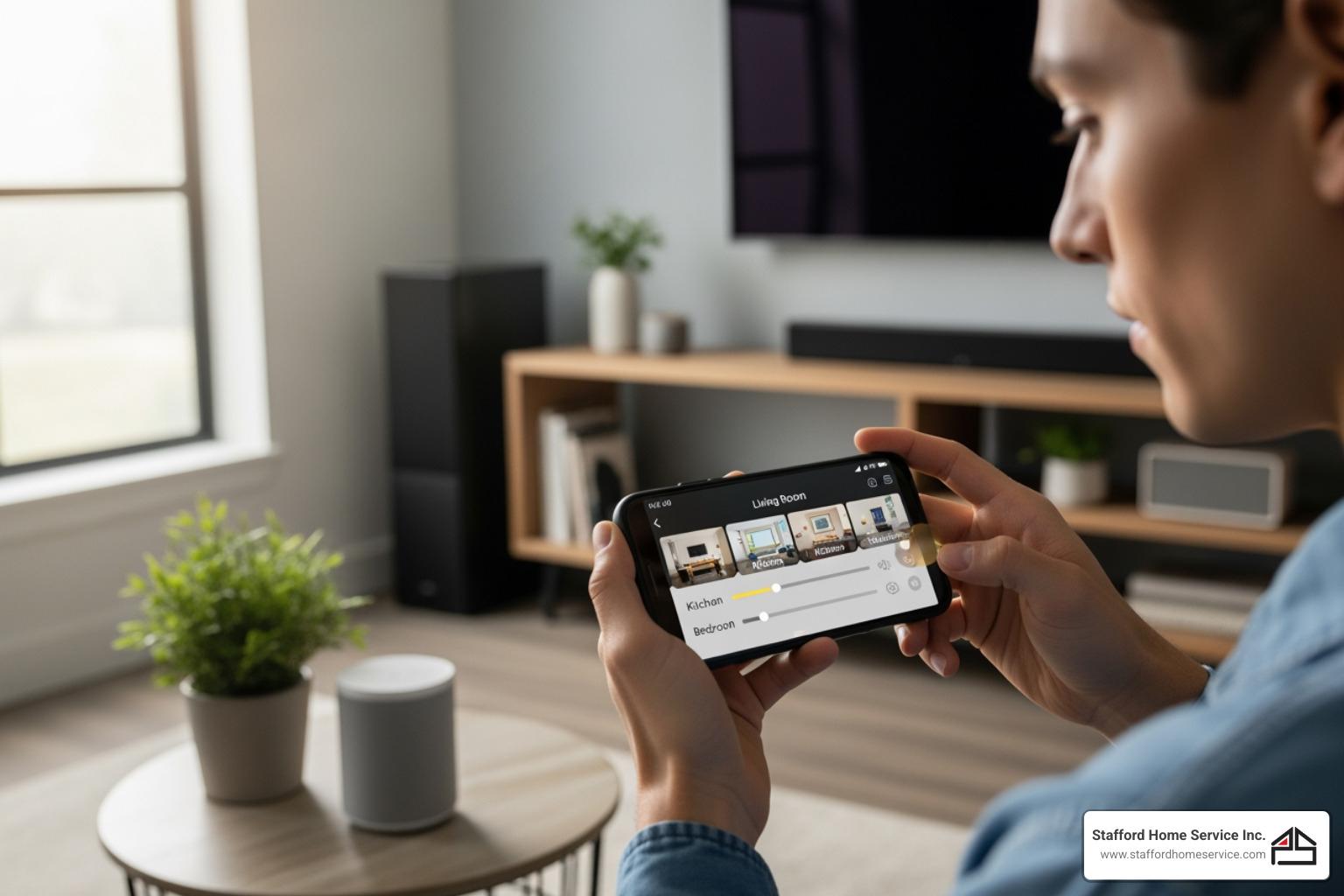
Your app interface becomes your command center for everything. Systems like Sony's Music Center app or Bluesound's BluOS Controller app put complete control at your fingertips. You can adjust volumes, manage playlists, and orchestrate your entire home's soundscape from your phone. The best apps feel natural to use, not like you need an engineering degree to figure them out.
Speaker grouping gives you incredible flexibility. Want the same song playing throughout your entire house for a party? Group all speakers together. Prefer jazz in the kitchen while someone else listens to podcasts in the bedroom? Create separate zones. This is where multi-room audio really shines compared to just carrying a single speaker around.
Built-in streaming service integration saves you steps and often improves sound quality. When your system supports your favorite services—Spotify, Tidal, Apple Music—directly in the app, features like Spotify Connect and AirPlay 2 can bypass your phone's audio processing entirely, streaming directly to speakers for better fidelity.
Power and Portability
Think about where your speakers will actually live. This decision shapes whether you need portable battery power or reliable wired connections.
Portable speakers with battery life offer freedom. You can take them to the deck for a barbecue, move them to the garage while you work on projects, or even pack them for a weekend getaway. Look for good battery life—at least 8 to 10 hours—and convenient USB-C charging. These speakers give you flexibility when your listening needs change throughout the day.
Most dedicated multi-room speakers, especially Wi-Fi models, need wired power. They're designed to stay put, plugged into outlets in your living room, bedroom, or kitchen. The upside? They deliver consistent, powerful performance without worrying about battery levels.
For the ultimate in clean, integrated audio, in-ceiling speakers and in-wall speakers blend completely into your home. You get excellent sound without any visible equipment cluttering your carefully designed spaces. These require professional installation and proper wiring, but the result is stunning. Our team at Stafford Heating, Cooling, Plumbing & Electrical has extensive experience installing these systems in homes throughout Andover, Blaine, Bloomington, and across Minnesota. We can help design a solution that delivers beautiful sound while maintaining your home's aesthetic.
Building and Managing Your Whole-Home Audio System
Creating a whole-home audio system is about more than just buying speakers—it's about building an ecosystem that works seamlessly with your lifestyle. The beauty of modern multi room bluetooth speaker set technology is that it grows with you, starting simple and expanding as your needs change.

The journey from your first two speakers to a complete whole-home audio experience should feel natural and intuitive. Whether you're just starting out or expanding an existing system, understanding how these pieces work together makes all the difference in creating the perfect soundscape for your home.
Can You Mix and Match Speaker Brands?
Here's where things get a bit tricky. Most dedicated multi-room systems operate within their own proprietary ecosystems, which means speakers from different brands typically won't sync directly for synchronized playback. It's a bit like trying to make different phone operating systems talk to each other—possible in some cases, but not always smooth.
The good news? There are several workarounds that give you more flexibility. Open platforms like Apple AirPlay 2 and Google Chromecast built-in act as universal translators for your speakers. If different speaker brands support the same open platform, you can often group them together within that framework. An AirPlay 2-compatible speaker from one manufacturer can stream audio simultaneously with another brand's AirPlay 2 speaker.
Amazon Alexa Multi-Room Music offers another solution for mixing brands. Any speakers with Alexa built-in can be grouped together through the Alexa app, regardless of who manufactured them. This opens up possibilities for creating custom combinations that fit your specific needs and budget.
The key is looking for shared streaming technologies when planning your system. If you want the absolute smoothest experience with the least hassle, sticking to one manufacturer's ecosystem generally works best. But if you already have speakers from different brands or want to gradually build your system over time, these open platforms give you the freedom to do so.
A Simple Guide to Setting Up Your Multi-Room Bluetooth Speaker Set
Setting up your multi room bluetooth speaker set is surprisingly straightforward these days. Most systems are designed with simplicity in mind, getting you from box to beautiful sound in just minutes.
Start by unboxing your speakers and placing them where you want them. Think about where you spend most of your time and where music would improve your experience. For wired speakers, you'll need power outlets nearby. Portable speakers should be charged up and ready to go.
Next, download the manufacturer's app to your smartphone—this becomes your command center for everything. The app guides you through connecting each speaker to your home Wi-Fi network, usually with just a few taps and your Wi-Fi password. For Bluetooth-only setups, the process is even simpler, with direct pairing to your phone.
Once your speakers are on the network, the real fun begins. Creating speaker groups lets you decide how your audio flows through your home. You might group all speakers together for parties, or create separate zones like "Upstairs," "Kitchen," and "Outdoor Patio" for more targeted listening. Most apps let you switch between these setups instantly.
The beauty of modern systems is their intuitive design. As one manufacturer notes, their players set up in minutes right out of the box. You don't need to be tech-savvy to get professional results. The apps walk you through every step, and customizing sound settings for each room becomes second nature after just a few adjustments.
Integrating Voice Assistants for Hands-Free Control
Voice control transforms your multi-room audio from a gadget you manage to a system that responds naturally to your needs. Integrating voice assistants means your music becomes part of your daily rhythm without interrupting what you're doing.
Most modern speakers work with Alexa, Google Assistant, or Siri, depending on the ecosystem you choose. The convenience is remarkable—you can start music while your hands are covered in flour from baking, adjust volume from across the room, or skip tracks while you're carrying laundry upstairs.
Simple voice commands like "Play jazz in the kitchen" or "Turn up the volume in the whole house group" become second nature. You can even control different rooms independently: "Stop the music in the bedroom" while keeping it playing everywhere else. This hands-free music control integrates seamlessly into your smart home, often allowing you to control lights, thermostats, and other devices through the same speaker.
The integration extends beyond just music playback. Many systems let you check weather, set timers, make announcements to other rooms, and even control your entire smart home ecosystem—all through voice commands. It's the kind of convenience that quickly becomes indispensable, especially in a busy household.
For homeowners planning a complete smart home setup with integrated entertainment systems, professional guidance can ensure everything works together perfectly. At Stafford Heating, Cooling, Plumbing & Electrical, we help design smart home solutions that fit your lifestyle across Andover, Blaine, Bloomington, and throughout Minnesota. Contact our team to discuss how we can improve your home's audio and entertainment capabilities.
Frequently Asked Questions About Multi-Room Audio
We often get asked about the practicalities of multi-room audio. Let's tackle some common questions to help you make an informed decision for your home.
Is a multi-room system better than just using several individual Bluetooth speakers?
Here's the honest answer: yes, a dedicated multi room bluetooth speaker set offers a much better experience than simply scattering individual Bluetooth speakers around your home and hoping for the best. While you can pair two Bluetooth speakers together for stereo sound (that's called TWS pairing), trying to get true synchronized audio across more than two speakers in different rooms using only standard Bluetooth? That's where things get tricky and often frustrating.
Think about what happens when you're walking through your home with music playing on separate, unconnected speakers. You'll hear annoying echoes and delays as the same song plays slightly out of sync in each room. Not exactly the seamless experience you're hoping for!
A proper multi-room system gives you synchronization—the same song playing perfectly in sync across your entire home. You get centralized control through a single app instead of juggling multiple connections. The group mode feature lets you decide whether all speakers play the same music or if you want different tunes in different rooms. Maybe you're listening to jazz in the kitchen while the kids have their playlist going in the playroom.
As audio experts point out, multi-room audio means speakers that can communicate with others on the same wireless network, typically Wi-Fi-enabled speakers that can simultaneously play the same or different audio on each speaker. This capability is simply beyond what individual Bluetooth speakers can reliably deliver on their own.
What is the typical range and reliability of a multi-room setup?
The range and reliability of your system depends heavily on which wireless technology powers it.
Bluetooth has its limits. Traditional Bluetooth typically reaches about 30-50 feet indoors, and that's under ideal conditions. Add in walls, furniture, and other obstacles, and you'll see that range shrink. While newer Bluetooth versions have improved somewhat, Bluetooth still isn't designed for whole-home coverage.
Wi-Fi is the real hero for multi-room audio. Because Wi-Fi systems use your existing home network, they can cover your entire home—often 100 feet or more, depending on your router and home layout. That's the kind of range you need for true whole-home audio.
However, there's an important catch: your multi-room system is only as reliable as your home's Wi-Fi network. A strong, stable Wi-Fi signal is essential for uninterrupted streaming and perfect synchronization across all your speakers. If you have Wi-Fi dead zones in certain rooms, you might experience dropouts or connection issues in those areas.
Both Bluetooth and Wi-Fi can experience interference from other wireless devices—think microwaves, cordless phones, or your neighbor's Wi-Fi network. But Wi-Fi systems are generally more resilient for multi-room applications.
If you're concerned about Wi-Fi coverage in your home, our team at Stafford Heating, Cooling, Plumbing & Electrical can help ensure your network is optimized for seamless smart home integration, including your multi-room audio system.
How do these systems handle high-quality audio formats?
This is where the technology you choose really matters. If you care about audio quality—and who doesn't?—you'll want to understand how different systems handle high-resolution audio.
Wi-Fi systems have a massive bandwidth advantage. They can stream Hi-Res audio up to 24-bit/192kHz, delivering lossless audio that preserves every nuance of the original recording. This means you're hearing music as the artist intended, with all the detail and depth intact. Systems like Bluesound have built their reputation on this "Hi-Res Way" of delivering audiophile-quality sound throughout your home.
Bluetooth has to compress audio to transmit it wirelessly, which inevitably means some loss of fidelity. Yes, advanced Bluetooth codecs like aptX HD or LDAC can transmit near-lossless audio, but they still can't match the uncompromised quality you get over Wi-Fi. Plus, both your phone and your speaker need to support the same advanced codec for it to work—it's not universal.
For spatial audio and Dolby Atmos, which create that immersive, three-dimensional soundstage, you absolutely need Wi-Fi. These formats require so much data bandwidth that Bluetooth simply can't handle them reliably. Speakers designed for spatial audio rely on robust Wi-Fi connections to deliver their full potential.
The bottom line? If high-resolution audio, lossless playback, or immersive spatial audio matters to you, a Wi-Fi-based multi room bluetooth speaker set (or more accurately, a Wi-Fi multi-room system) will deliver the superior performance you're looking for.
For Ultimate Reliability, Consider a Professional Installation
While wireless multi room bluetooth speaker set systems offer incredible convenience and ease of setup, there's something to be said for the rock-solid reliability of a professionally installed system. Don't get me wrong—wireless technology has come a long way, and for many homeowners, it's the perfect solution. But if you've ever experienced a dropped connection during your favorite song or noticed dead zones where your Wi-Fi just doesn't reach, you know that wireless isn't always perfect.
Here's the thing about wireless systems: they're amazing until they're not. Signal interference from other devices, Wi-Fi dead zones in certain rooms, and the occasional network hiccup can interrupt your listening experience. And while these issues might be minor annoyances when you're just streaming a podcast, they become more noticeable when you're trying to create that perfect ambiance for a dinner party or enjoy high-fidelity audio throughout your home.
That's where a professionally installed wired audio system truly shines. At Stafford Heating, Cooling, Plumbing & Electrical, we've helped countless homeowners across the Twin Cities transform their audio experience with distributed whole-house audio systems that simply work, every single time.
A wired system bypasses all those wireless headaches. There's no competition for bandwidth, no interference from your neighbor's Wi-Fi, and no worrying about whether your router can handle streaming to six speakers simultaneously. The audio signal travels through dedicated wiring, delivering consistent, pristine sound to every room without compromise.
The benefits go beyond just reliability. Superior sound quality is perhaps the most noticeable difference—wired connections can handle the highest fidelity audio formats without any compression or loss. In-ceiling and in-wall speakers blend seamlessly into your home's architecture, creating a clean, sophisticated look without visible wires or bulky speakers sitting on shelves. And here's something many homeowners don't consider: a professionally installed whole-house audio system can actually increase your home's value. It's an investment that you'll enjoy every day and that future buyers will appreciate.
We understand that smart home wiring is the foundation of any truly integrated home system. Just as robust wiring ensures seamless communication between all your smart devices, the same principle applies to your audio. Our team has the expertise to design and install the infrastructure your home needs for optimal performance, whether that's audio, lighting, security, or climate control.
Our service area covers the entire Twin Cities region, including Andover, Blaine, Bloomington, Burnsville, Eden Prairie, Maple Grove, Minneapolis, St. Paul, and many surrounding communities. We bring the same commitment to quality workmanship and complete customer satisfaction to every project, backed by our flexible financing options.
If you're ready to explore what a professionally installed system could do for your home, we'd love to talk. Our experienced team can help you design an audio experience that fits your lifestyle and your home perfectly. Reach out to us today to discuss how we can transform your home's audio into something truly special—because great sound shouldn't come with frustration.
Customer Testimonials
Our customers consistently praise our knowledgeable technicians, prompt service, and the lasting quality of the work we deliver.